
At UVA, they already do. Nearly 30% of what Virginia families pay in tuition is set aside to cover other students' bills. It's 18.3% for out-of-state students. Tuition keeps going up for everyone. And it is over 70% of UVA families who are paying for the families receiving tuition aid.
Imagine your landlord raising your rent, again and again. Then you learn that about $28.50 of every $100 you pay doesn't go to your apartment at all. It covers the rent of other tenants who earn less than you do. And your rent keeps rising.
You would have questions, wouldn't you? Why is this happening? Who decided it? Why wasn't I told? And you would justifiably be upset, wouldn’t you?
That is how the system works at UVA.
In 2024–25, Virginia undergraduates paid UVA $225.7 million in tuition. UVA set aside $64.4 million of it, 28.5%, as financial aid for other students, according to its own 2025 six-year plan. No public university in Virginia sets aside a bigger share of its in-state tuition. And in April, the Board of Visitors raised tuition again, by 3.6%.
Most of that "set-aside" money funds AccessUVA, UVA's need-based aid program. In 2024–25, 29% of UVA's full-time undergraduates had "demonstrated need" and qualified for it, according to UVA's own figures. The other 71% did not. Their families pay what UVA charges, and part of that payment covers the other 29%.
No matter what name you put on it, this is institutional socialism. And it is not even "Robin Hoodism." UVA is not taking from the "rich" to give to the "poor." In many cases it is forcing middle-class families into debt to pay for free tuition for others who may even have a higher standard of living. On many levels it is utterly unfair.
Where the "scholarship" money comes from
Picture first-year students applying for aid. UVA's "How to Apply for Financial Aid" page tells them UVA meets 100% of need "with scholarships, grants, work-study and need-based loans," and that "generous donors provide much of the scholarship and grant funding." As of October 30, 2026, the page never once mentions "tuition" as a source. Go scroll down to the bottom and see for yourself.
Generous donors are not the biggest source. Other families' tuition payments are. The last time UVA published a full dollar breakdown of its need-based grants by source, in 2015–16, endowment and gifts covered $10.8 million of $86.5 million, about one dollar in eight. Tuition covered $52.9 million, about 61%. By 2021–22, the last year UVA published how much of its aid came from tuition, tuition paid for about 63% of all need-based grants.
A good goal, but the wrong way to pay for it
Helping talented students who can't afford UVA is a worthy goal. Few people would argue with that. The question is who pays for it. UVA has answered that question by charging a majority of families more, including families who may be just as deserving as those receiving free tuition.
UVA's own description of how AccessUVA is supposed to be funded puts tuition last. Federal Pell grants, state grants, donor scholarships and work-study come first. Tuition is the "last resort," used only to close whatever need is left. But that "last resort" grew fourfold in AccessUVA's first decade alone.
In AccessUVA's first year, 2004–05, UVA spent about $11.5 million in tuition on grants for other students. By 2014–15, it was about $47 million. UVA's own charts first labeled this money "unrestricted institutional grants," then renamed it "tuition grants," and finally just "tuition." Then in 2015, UVA raised tuition by $1,000 for entering Virginians to pay for grants that replaced student loans, and another $1,000 the next year.
That same year, UVA told the state it would take a $1 billion endowment to replace the grants that tuition was funding. But tuition-funded grants didn't shrink. They kept growing.
In 2016, UVA staff told a Board committee, "We are increasingly reliant on tuition to sustain AccessUVA." Ten years later, it is now even more reliant:
For 2016–17, UVA set aside about 16% of in-state undergraduate tuition for aid, according to its six-year plan. By 2024–25, the latest year reported, it was 28.5%, and the dollars had nearly tripled, from $22.5 million to $64.4 million.
UVA has also asked the state several times, in its 2019 and 2021 six-year plans and its 2022 update, for "no restrictions" on using in-state tuition for in-state aid.
Every Virginia public university has to report how much tuition it sets aside, in a plan it files with the state, under the label "tuition revenue for financial aid." UVA leads the state.
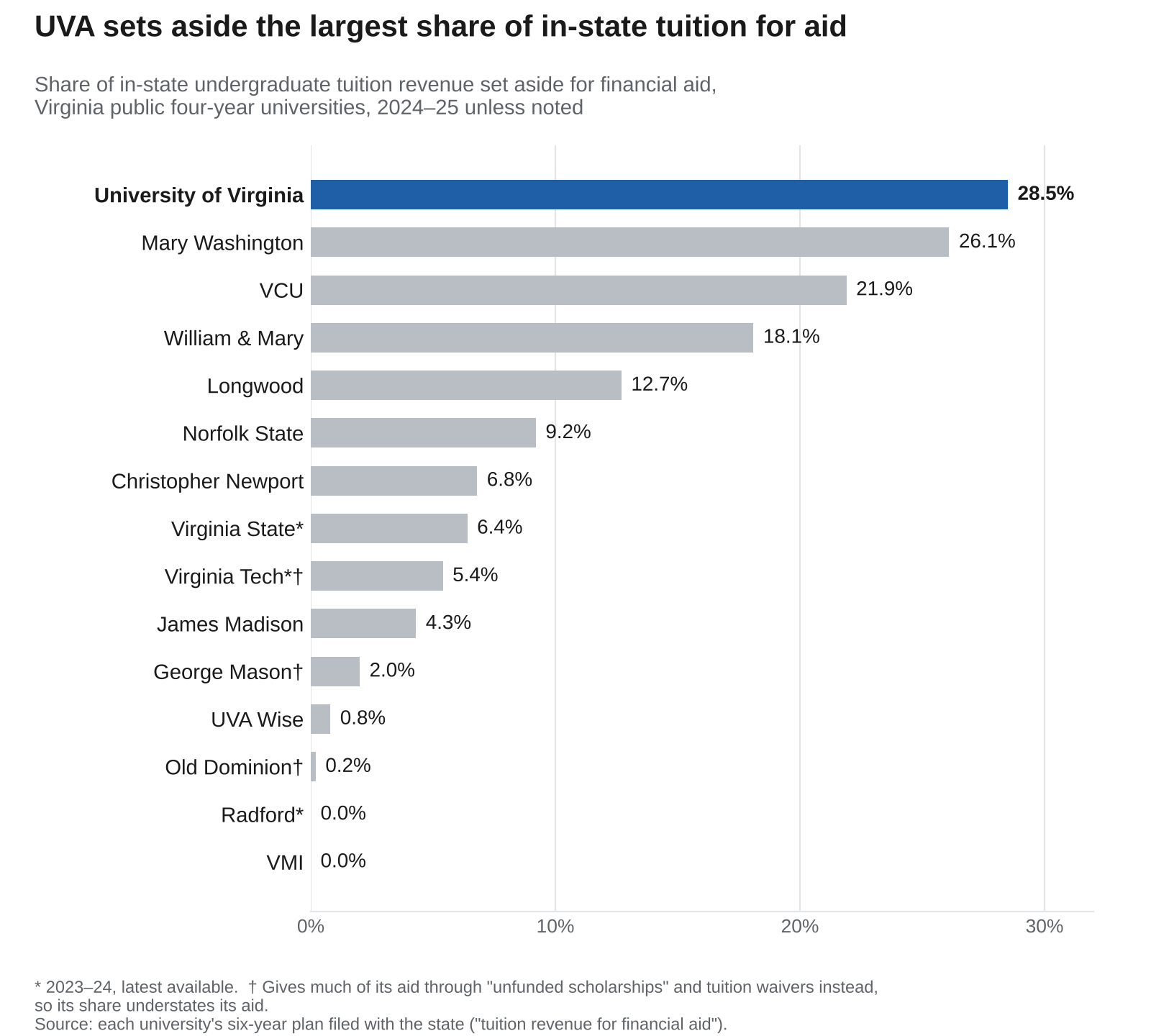
By the way, you might think that out-of-state families, who pay a much higher price to attend UVA, put more of their tuition toward AccessUVA. You'd be wrong. They put in less. In 2024–25, out-of-state undergraduates paid UVA $319.3 million in tuition, about $93.6 million more than Virginians paid. Yet UVA set aside less of their money for financial aid: $58.3 million, or 18.3%, compared with the $64.4 million, or 28.5%, from Virginia families.
In other words, the students paying the lower in-state price are the ones carrying more of the aid burden overall.
Why the middle class gets hit hardest
Which families does AccessUVA leave most exposed? UVA staff showed its own Board exactly who they are. At a Board retreat on June 6, 2026, staff walked members through four sample students. One was "Jessica." Her parents are two Northern Virginia teachers. Together they earn $184,500 a year and have $245,000 in savings and a rental property.
UVA decided Jessica's family needs no help. Instead of a scholarship, it offered a payment plan, a $4,500 loan in Jessica's name and a $20,000 federal loan in her parents' names. Full price for a Virginian is about $43,178 a year.
Jessica isn't real. UVA made her up. But Board members recognized her. Families like hers, they said, often take out home equity loans to pay for UVA, according to the minutes. So the Board recognized that some middle-class families would have to go into debt to finance free tuition for other students. How insane is that? What were these people thinking, if they were thinking at all?
Here is how UVA's guaranteed aid works for Virginia families, by income:
Under $50,000: scholarships cover tuition, fees, housing and food.
Under $100,000: scholarships cover tuition and fees.
Under $150,000: a scholarship of $2,000, called the Cornerstone Grant.
Over $150,000: UVA's guarantees stop.
Each guarantee also has an asset limit: $100,000 for the first two, $150,000 for the $2,000 grant. Out-of-state students with need get aid too – but without these guarantees.
There are so many problems with this system that it is hard to know where to begin. Start with the cutoffs, which are arbitrary. A family earning $99,000 is guaranteed free tuition and fees if its assets are also under $100,000. At $101,000, the guarantee drops to $2,000. Is that reasonable? The $2,000 covers less than 5% of a year at UVA, and none of these limits rises with inflation. The grant itself hasn't grown since it began in 2017: it was $2,000 then and is $2,000 now. Only the income cutoff has moved, from $125,000 to $150,000 in 2023. But let’s be real—$2000 really is a slap in the face to UVA families.
Where a family lives doesn't count either. Is $110,000 in Arlington or Alexandria the same as $110,000 in Richlands or Covington? As far as UVA's public documents show, its formula treats them the same. In 2016, staff showed a Board committee an option that would have adjusted for the high cost of living in places like Northern Virginia. The Board ignored it.
But most of all, it is unfair to make one family pay tuition for another, especially when that family has to go into debt to do it. AccessUVA should be funded by public money, private donations and student work programs — not by the indebtedness of middle-class families.
The Board knew, and kept the method
The Board has seen the middle-class problem for at least a decade, and other ways to pay have been on the table.
2016: UVA told state legislators its new Strategic Investment Fund (SIF) would improve affordability "without passing on the investment costs in the form of higher tuition," and told the Board it could "reduce our reliance on tuition." Staff also showed the Board that a $150,000 family of four got no aid, and priced three ways to help middle-income Virginians. The Board adopted none of them.
2017: The Board created the $2,000 grant and set aside $13.5 million from the SIF to pay for it. Only about $700,000 was spent. The rest went back to the SIF because "AccessUVA funds were covering most of the costs."
2021: President Jim Ryan promised a study of UVA's prices and aid. None appears in the public record.
2023: The Board raised the grant's income limit to $150,000. Ryan said it would cost about $1 million a year, "covered entirely by philanthropy." The minutes record no questions. Yet UVA's tuition set-aside for in-state aid jumped $13.1 million that year, before the expansion began, and another $5.6 million the next. No public report shows what the expansion costs or who pays for it.
2026: In April, Board members worried about families "just above the AccessUVA thresholds" and asked for numbers by income, then approved the 3.6% increase. Two months later, they got four sample families instead.
UVA stopped showing the numbers
For years, UVA's quarterly reports to the Board included a one-page report card on AccessUVA. The last one, posted in March 2024 with numbers for 2022–23, dropped the tuition figure. UVA posted one more quarterly report, dated May 2024, with no report card at all. It has not posted a quarterly report since.
We started asking for AccessUVA's numbers more than a month ago. In September, UVA's media office took nine days to reply, then pointed to documents that don't contain them.On October 8, we filed a request under the Virginia Freedom of Information Act (FOIA).
As of this publication, UVA still has not provided any of the hard numbers: the metrics, reports, or costs. Our full requests and exchanges with UVA's media and FOIA offices appear at the end of this article.
Meanwhile, families are paying for other students' aid, and UVA won't say how much. This is not “affordability.”
Back to the rent, and to tuition
Go back to that apartment. Your rent goes up every year. Nearly 30% of it covers other tenants. The landlord once promised a separate fund would keep your rent down, then quietly leaned on your rent instead, and more of it each year. A brochure thanks "generous donors." When you ask for the numbers, the landlord stops providing them.
Most people would be outraged by that, and justifiably so.
UVA promises to meet 100% of every student's demonstrated need. For 71% of UVA undergraduates, that need is zero. They pay the full price, plus whatever increase comes next, and part of every tuition payment covers someone else's.
AccessUVA's goal is a good one. So are fairness and transparency. UVA families deserve a say in how the program is paid for, and a straight answer about how much they are already paying. Most of all, they should not have to pay for other students while their own tuition keeps rising–many of them having to go into debt to do so. Where does one draw the line on fairness? The bottom line is the metrics being used are on its face unfair, and in many cases exceedingly so.
Go here to read the UVA Media request and responses.
Go here to read the FOIA request and responses.