

Our OBJECTIVES
The Jefferson Council is made up of a robust network of concerned and invested alumni who are committed to leading the University of Virginia back to Thomas Jefferson’s legacy of freedom and excellence. Our events, original research, and valuable partnerships work in coordination toward this mission by championing the following four objectives.
Promote a culture of civil dialogue, intellectual diversity, and the free exchange of competing ideas
The Jefferson Council and our members are committed to promoting a culture of civil dialogue, intellectual diversity, and the free exchange of competing ideas at the University of Virginia through our events, original content, and partnerships. This honors the “illimitable freedom” of the human mind, “for as long as we may think as we will and speak as we think, the condition of man will proceed in improvement.”
“In every country where man is free to think and to speak, differences of opinion will arise from difference of perception, and the imperfection of reason. but these differences, when permitted, as in this happy country, to purify themselves by free discussion, are but as passing clouds overshadowing our land transiently, and leaving our horizon more bright and serene.”
Articles on this objective from the TJC universe
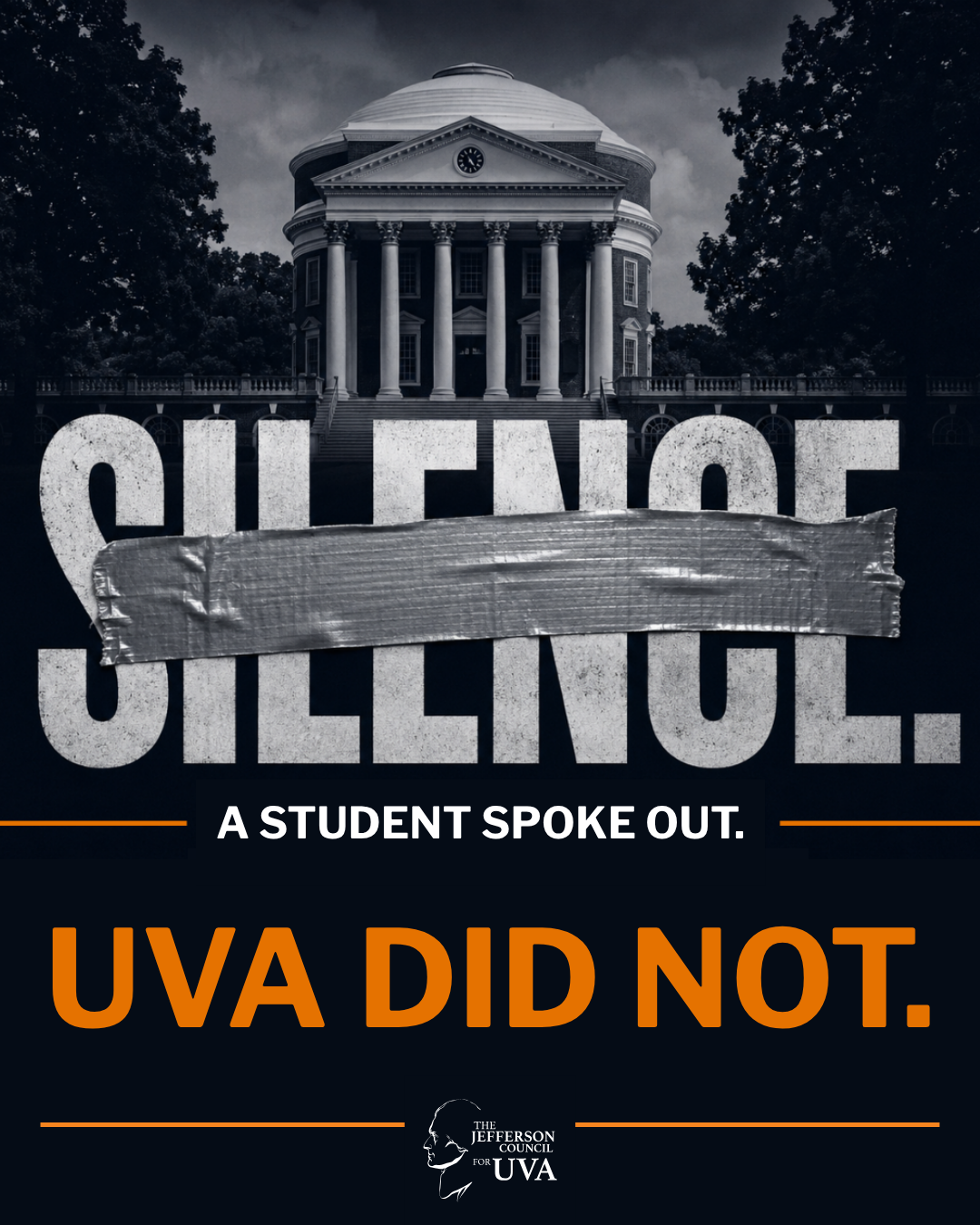
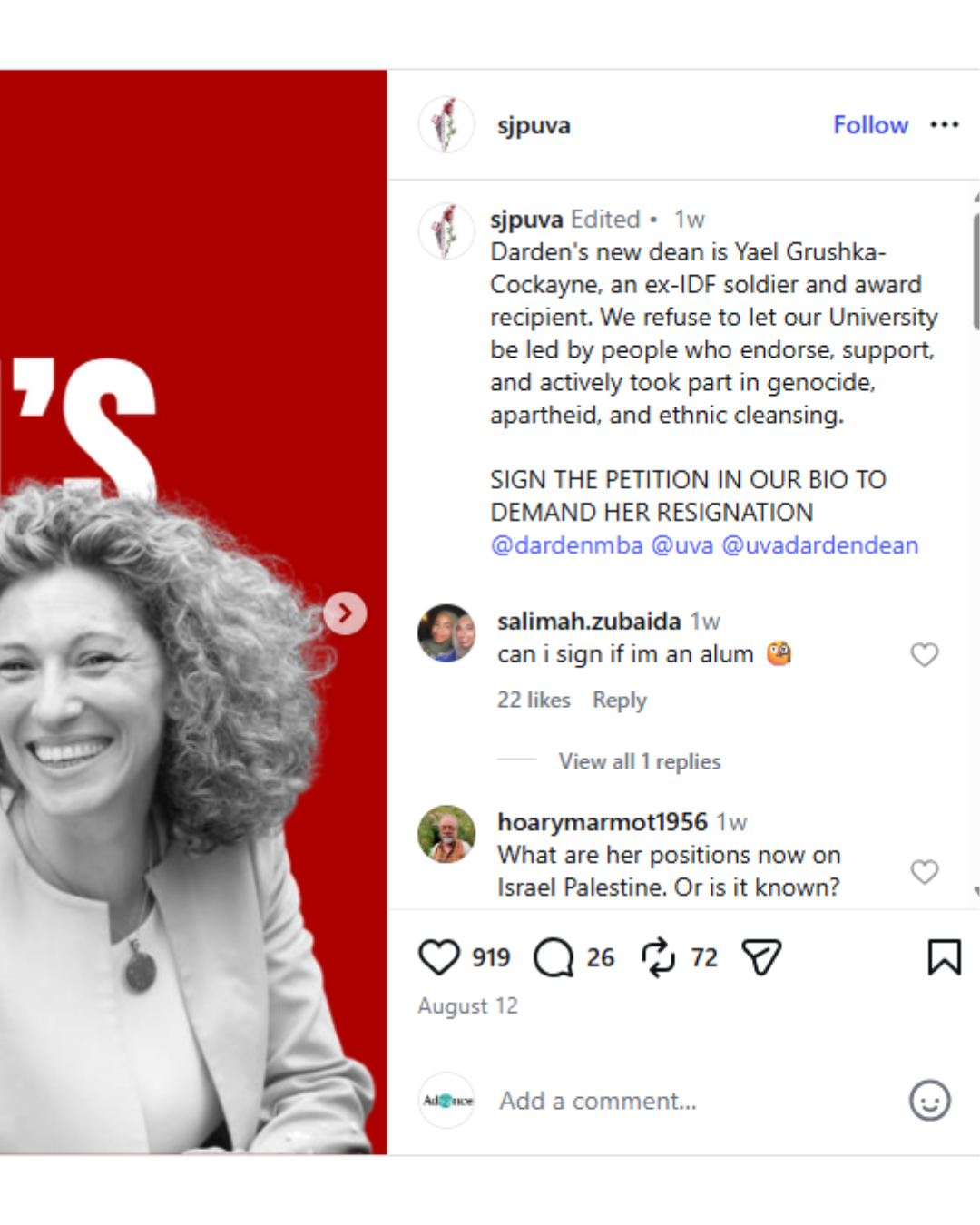
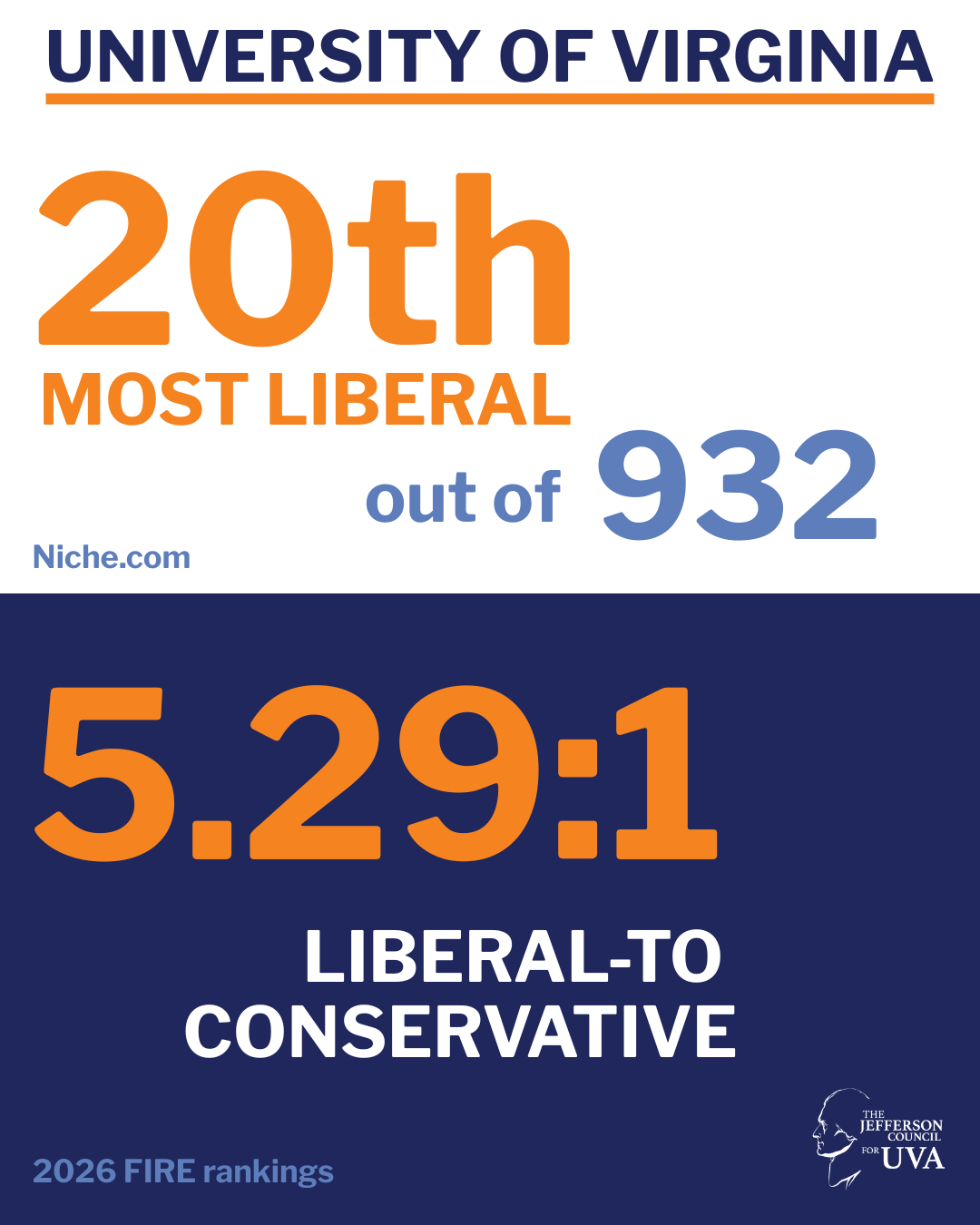

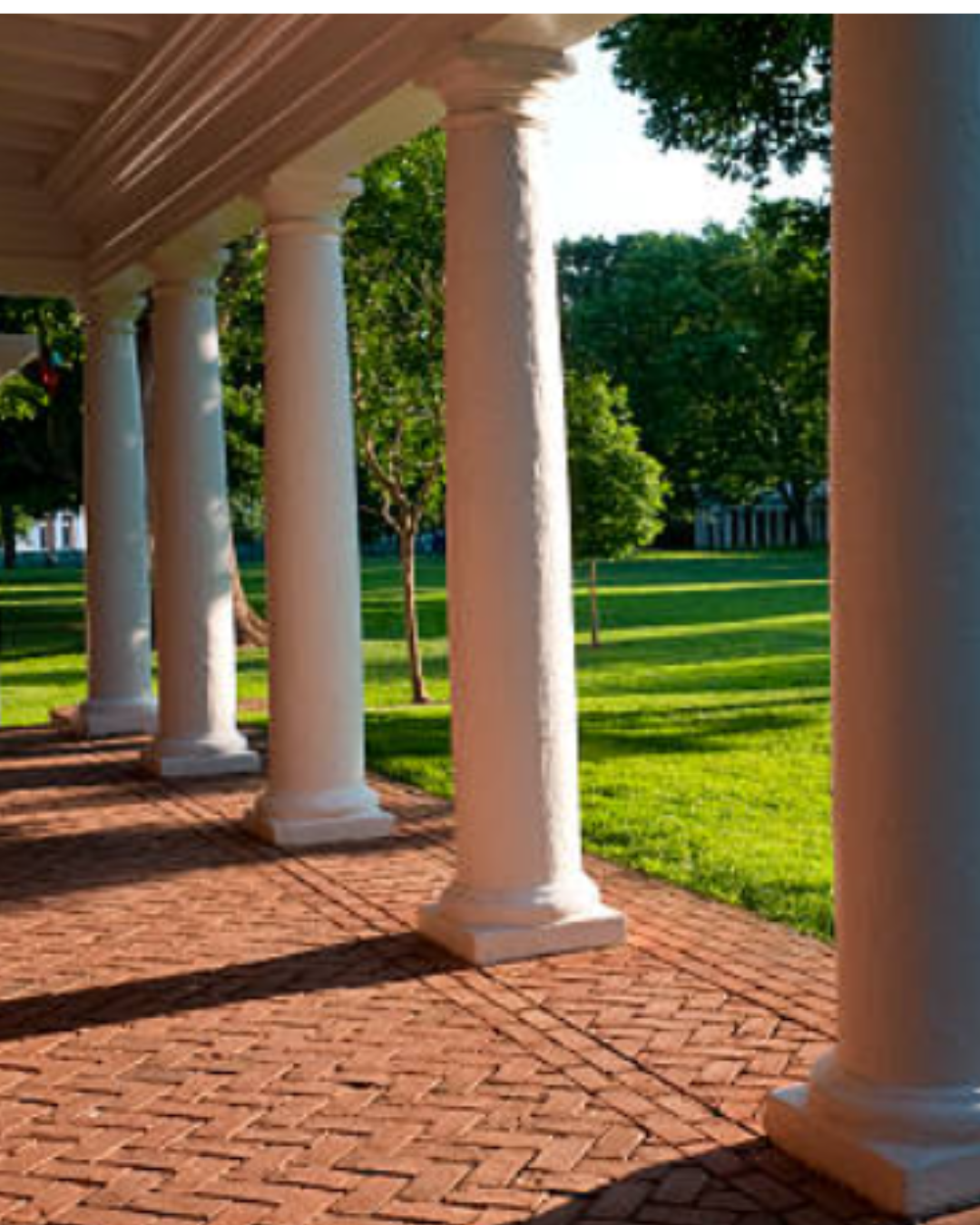


Bert Ellis has been the Board’s most consistent and vocal advocate for transparency, accountability, and responsible governance. Removing him now sends the wrong message to students, faculty, alumni, and the broader UVA community.
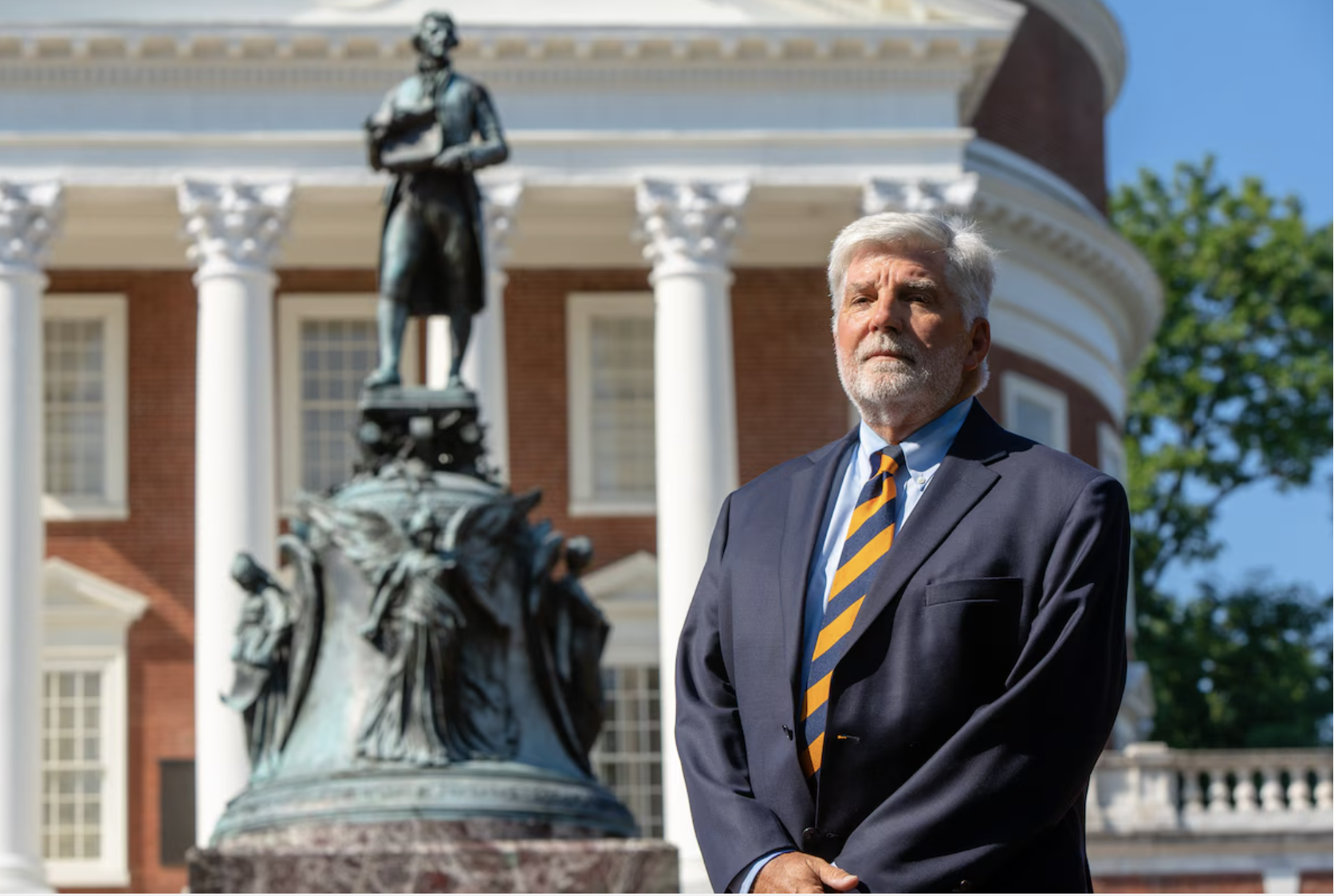
“UVA can once again be a beacon of excellence, the shining city on the hill, and a model for the nation. That is my mission. I have been steadfast in this fight, and I will remain so—regardless of the Governor’s decision.“

Governor Glenn Youngkin has fired Bert Ellis from the University of Virginia Board of Visitors, terminating the most outspoken member of the board supporting his goals of reining in tuition, promoting free speech and intellectual diversity, and eliminating diversity, equity, and inclusion (DEI) from the University’s policies and practices.

Who leaked police-cam videos meant to embarrass Bert Ellis to The Washington Post? If we knew the answer to that, we could get a clearer view of the behind-the-scenes power play to shape the future of the University of Virginia.

Having bragged on national cable news that “DEI is done” at the University of Virginia, Governor Glenn Youngkin now is asking for the resignation of the man most determined to ensure that DEI is, in fact, laid to rest.
What might a meritocratic admissions system at the University of Virginia look like now that the Board of Visitors has banned racial preferences across the board?

At the direction of Board of Visitors Secretary Susan Harris, a compilation of nearly 50 letters and email messages to the Board and President Jim Ryan was distributed to Board members Tuesday. The letters were almost uniformly critical of the Board’s decision earlier this month to abolish the office of Equity, Inclusion, and Community Engagement.

One might think that revamping a website would be an easy start to complying with the Board of Visitors’ order to dismantle the Division for Diversity, Equity, and Inclusion (DEI) at the University of Virginia. Retitle the home page. Put up an “Under Construction” logo. Post a statement indicating that changes are coming. Do something! But a full week after the Board’s unanimous vote, the website still stands, as if nothing had changed.

Decision-making at the University of Virginia is shrouded in secrecy — and leadership is just fine with that.


TJC urges the UVA Board of Visitors to take a strong stand for the Kalven Principles and to embrace this opportunity to return the University to its true mission: the pursuit of knowledge and truth without political interference.

The University of Virginia’s “Rising Scholars” program in the College of Arts and Sciences, which dispenses graduate fellowships exclusively to racial, ethnic, sexual and gender minority students, has ceased accepting applications, according to a posting on its website. The website provides no explanation, but…

Now comes the battle to replace the University of VIrginia’s provost Ian Baucom. The University has assembled a fourteen-person group to launch a national search, according to an announcement in the UVA house organ UVA Today.

Restore fiscal stewardship and ACADEMIC accountability
Mr. Jefferson wanted his university to be a place for useful knowledge and the free discussion of ideas. Today, the UVA administration has instead decided to prioritize ideological agendas, resulting in wasteful spending, soaring tuition costs, discriminatory faculty selections, and a toxic monoculture. Our team is shining a light on the facts, calling on UVA’s Board of Visitors to recommit themselves to fiscal accountability and academic excellence. Check out the many ways we are doing this alongside our members and partnership network.
“It’s object should be defined only generally for teaching the useful branches of science; leaving the particulars to the direction of the day.”
Articles on this objective from the TJC universe
Bert Ellis has been the Board’s most consistent and vocal advocate for transparency, accountability, and responsible governance. Removing him now sends the wrong message to students, faculty, alumni, and the broader UVA community.

After more than a year of delays, the University of Virginia has finally released two reports ordered by the Attorney General — one detailing the University Police Department (UPD) response to the Nov. 13, 2022, mass shooting at UVA, and one reviewing the failure of the University’s Threat Assessment Team (TAT), despite abundant red flags, to prevent the tragedy.
At the direction of Board of Visitors Secretary Susan Harris, a compilation of nearly 50 letters and email messages to the Board and President Jim Ryan was distributed to Board members Tuesday. The letters were almost uniformly critical of the Board’s decision earlier this month to abolish the office of Equity, Inclusion, and Community Engagement.
One might think that revamping a website would be an easy start to complying with the Board of Visitors’ order to dismantle the Division for Diversity, Equity, and Inclusion (DEI) at the University of Virginia. Retitle the home page. Put up an “Under Construction” logo. Post a statement indicating that changes are coming. Do something! But a full week after the Board’s unanimous vote, the website still stands, as if nothing had changed.
Decision-making at the University of Virginia is shrouded in secrecy — and leadership is just fine with that.


Last week the University of Virginia Board of Visitors met to discuss one of the most contentious public-policy issues roiling American politics today: the medical treatment of transgender youth. The meeting was closed to the public, and board members were enjoined not to reveal what was said.


Don’t question university overhead costs or thousands will die! That is essentially the message of Virginia’s big three research universities — Virginia Tech, the University of Virginia, and Virginia Commonwealth University — in response to a National Institutes of Health initiative capping reimbursable overhead costs to 15% of the research grants it dispenses. And I’m not exaggerating about the “thousands will die” part.

The last few months have been the most trying time in Ryan’s six-and-a-half-year tenure. After enjoying tremendous initial success in implementing his priorities at UVA, he is now mired in endless controversies which threaten to unravel his legacy.

This is the third and final part of a new three-part series exploring the influence of UVA President Ryan’s Strategic Investment Fund.


This is the second part of a new three-part series exploring the influence of UVA President Ryan’s Strategic Investment Fund.

Ian Baucom will step down as provost of the University of Virginia in March to become president of Middlebury College in Vermont. UVA will launch a national search for his replacement, the university announced today. His departure will likely set off a power struggle between President Jim Ryan and members of the Board of Visitors appointed by Governor Glenn Youngkin.

This is the first part of a new three-part series exploring the influence of UVA President Ryan’s Strategic Investment Fund.

My FOIA journey began in 2021, soon after the University of Virginia released its “free speech” statement. I was disappointed with it, thinking it lukewarm and empty of enforcement — a fig leaf resulting from the alumni outcry arising out of the poor handling of the F--- UVA Lawn door.

A bill introduced in the General Assembly would require public four-year institutions to record, archive, and make Boards of Visitors meetings available to the public for five years.

The University of Virginia’s 2030 Plan for creating “a great and good university” lists ten key initiatives, one of which is its “good neighbor program.”

Time is running short for Governor Glenn Youngkin to make his mark on the University of Virginia. His appointees to the Board of Visitors now comprise a 13-to-4 majority, yet after almost a half year, they have failed to make a visible dent in the priorities set by President Jim Ryan.

Matan Goldstein, the Jewish student who was subjected to repeated antisemitic treatment at the University of Virginia, has settled his lawsuit against the University. Terms of the settlement were not revealed. While the public cannot know how much UVA paid, if anything, to make the problem go away, we can get a sense of how much it spent on legal fees.

Bert Ellis was mad as hell and wasn’t going to take it anymore. He didn’t reenact Peter Finch playing Howard Beale in his famous rant in the movie “Network.” In fact, he was very calm and deliberate. But he made it clear to the University of Virginia Board of Visitors Thursday that he had run out of patience. He would refuse to vote in favor of any new spending project until the University got serious about cutting costs, Ellis said.

A senior tenured faculty member has anonymously expressed concerns about various circumstances prevalent on Grounds. This professor wishes to remain anonymous due to fear of retaliation by the administration. One of the matters he/she discusses is the deterioration of our Honor System, focusing on the "secession" by the faculty from the System.

It’s time for UVA officials to release the Attorney General’s report into the university actions leading up to the shooting, which resulted in the deaths of three UVA football players.
That’s what UVA leadership promised. Now it’s time to make good on that promise.

Once again, the UVA’s BOV is conducting the ritual of pretending to be involved in setting rates for tuition, fees, room and board — but the minutes record no comments or questions by any board member.

Past UVA boards have passively accepted whatever numbers the administration dished out to them. The Jefferson Council is hopeful that the new board, dominated 13-to-4 by appointees of Governor Glenn Youngkin, will take a more assertive approach to cost control and tuition increases.

“The administration of the university and the health system are not involved and will not be involved in any aspect of deciding what evidence to obtain, reviewing evidence, or supervising the investigation.“

Preserve the beauty of the Lawn as THE historic center of The academicAL Village
When he designed UVA’s Grounds, Mr. Jefferson aimed to create an environment where students could learn both inside and outside of the classroom. The Lawn demonstrates Mr. Jefferson’s love of beauty and serves as the historic center of his academic village and the symbolic center of UVA. As such, it has been designated as a US National Historic Landmark District and is one of only twenty-six UNESCO World Heritage Sites in the United States.
“The whole of these arranged around an open square of grass and trees would make it, what it should be in fact, an academical village, instead of a large and common den of noise, of filth, and of fetid air.”
Articles on this objective from the TJC universe

The Board of Visitors and President of the University have a duty to the people of the Commonwealth of Virginia to preserve the beauty and dignity of the Academical Village as a UNESCO World Heritage site. The current regulations have proven inadequate and unenforceable.

Read The Jefferson Council President Tom Neale's letter to the UVA Board of Visitors, included in TJC's Fall 2024 BOV Welcome Brief.

In Monticello’s realm, where dreams and doubts collide, I find within the past a guiding light, And hope that through our journey’s winding tide, We honor all who dared to stand and fight.
As an organization committed to those Jeffersonian principles which formed UVA 205 years ago, The Jefferson Council is prepared to serve as an independent source of information and analysis for the new Board of Visitors.

Nominate individuals who will have the grit to fight for the university, its history, its legacy, and its students.

Like the Bolsheviks of yore, UVA militants have turned upon Ryan and Baucom with a vengeance. TJC contributing editor Jim Bacon weighs in.

From professors to Lawn residents, members of the University of Virginia community continue to criticize senior UVA leadership for shutting down the UVA Encampment for Gaza "liberated zone."

The University of Virginia called in the Virginia State Police to disperse "UVA Encampment for Gaza" protesters, said President Jim Ryan, University Police Chief Tim Longo, and other University leaders in a virtual town hall.

Alumnus to TJC after UVA tour: “No history lesson of the Grounds, its architecture, or its purpose. No homage to TJ and his vision for the advancement of an enlightened society. No fabled stories about the secret societies, or traditions at the sporting events or around Grounds. Nothing.”

Perhaps Ryan could draw spine-stiffening inspiration from the University's founder Thomas Jefferson, who dealt with student riots in 1825.

TJC executive director Jim Bacon joins the John Reid show to discuss political signage on UVA's Lawn doors. Does this violate the Lawn as a UNESCO World Heritage Site?

Champion and reinvigorate the Honor System
One of UVA’s oldest and most distinct traditions, the Honor System is a reflection of our students’ longstanding commitment to integrity and excellence. It is becoming increasingly concerning that the Honor System is being weaponized against students who do not fit the preferred ideological narrative. The Jefferson Council is monitoring and sharing stories from students, parents, and faculty who are dedicated to the original spirit of the Honor System.
“I am sure that in estimating every man’s value either in private or public life, a pure integrity is the quality we take first into calculation, and that learning and talents are only the second. After these come benevolence, good temper &c. But the first is always that sort of integrity which makes a man act in the dark as if it was in the open blaze of day.”
Articles on this objective from the TJC universe

The Jefferson Council has received a letter from a senior University of Virginia faculty member who, for fear of retaliation, asks to remain anonymous. He outlines what he calls “generic” concerns of the UVA faculty. The first focuses on a critical dysfunction of the Honor System.

If such bullying behavior is shown to be the norm for some types of students and not others, UVA has a very big problem.

The University of Virginia Honor System is governed by students, but the Board of Visitors is enjoined by its mission statement to support and uphold the Honor System. Here's what the Board can do to strengthen the culture of Honor at UVA without infringing upon student sovereignty.
Read The Jefferson Council President Tom Neale's letter to the UVA Board of Visitors, included in TJC's Fall 2024 BOV Welcome Brief.
As an organization committed to those Jeffersonian principles which formed UVA 205 years ago, The Jefferson Council is prepared to serve as an independent source of information and analysis for the new Board of Visitors.
As an organization committed to those Jeffersonian principles which formed UVA 205 years ago, The Jefferson Council is prepared to serve as an independent source of information and analysis for the new Board of Visitors.
Nominate individuals who will have the grit to fight for the university, its history, its legacy, and its students.
Perhaps Ryan could draw spine-stiffening inspiration from the University's founder Thomas Jefferson, who dealt with student riots in 1825.
Morgan Bettinger has resolved her lawsuit with the University and its administrators. Learn more about her case and allegations of the UVA Administration’s responsibility for the alleged deprivations of her federally protected civil rights.

Honor Council members believe in the Honor Code and their efforts are to be commended. But if students are unwilling to turn in offenders, and if the faculty reformats its tests in lieu of prosecuting cheaters, then the "community of trust" does not seem to be working as advertised.

Morgan Bettinger was found guilty of violating UVA's Standards of Conduct after she was overheard speaking to a garbage truck driver and was accused of making a threat. The student judiciary instituted a punishment in the form of compelled speech to avoid expulsion.