
UVA's administrators have grown more than ten times as fast as its students since 2013
Upon founding the University, Mr. Jefferson made the decision to have no president, instead entrusting leadership of the institution to the chairman of the faculty. This fit perfectly with Jefferson's distrust of centralized authority. UVA did not create the position of chief executive until 1904, when Edwin Alderman became the first president.
It took less than 100 years for UVA to morph from no president at all, to a central executive model in the 20th century, and finally to the sprawling and bloated professional bureaucracy we see today.
The most important priorities for any university should be students first, the faculty second, and third an administration that exists to serve them both. But at UVA we have seen these priorities reshuffled in both numbers and dollars.
Our first article in our series about affordability was about the explosion in student tuition and costs. This one begins our discussion about why these costs keep climbing. Let's start by focusing on this fact: Over the past decade, UVA's administrators have grown eleven times as fast as its students and over four times as fast as instructional staff.
How that happened
The story unfolds with the official facts and numbers in the period 2013-2024. In 2024, the General Assembly's own audit agency, JLARC, published UVA's staffing by occupation for fall 2013 and fall 2022 in a report on higher-education spending. We took the same federal sourced data and carried it forward two more years and counted exactly the same way. The numbers below cover the University's Academic Division, including the School of Medicine, but not the hospital, and are measured in full-time equivalents.
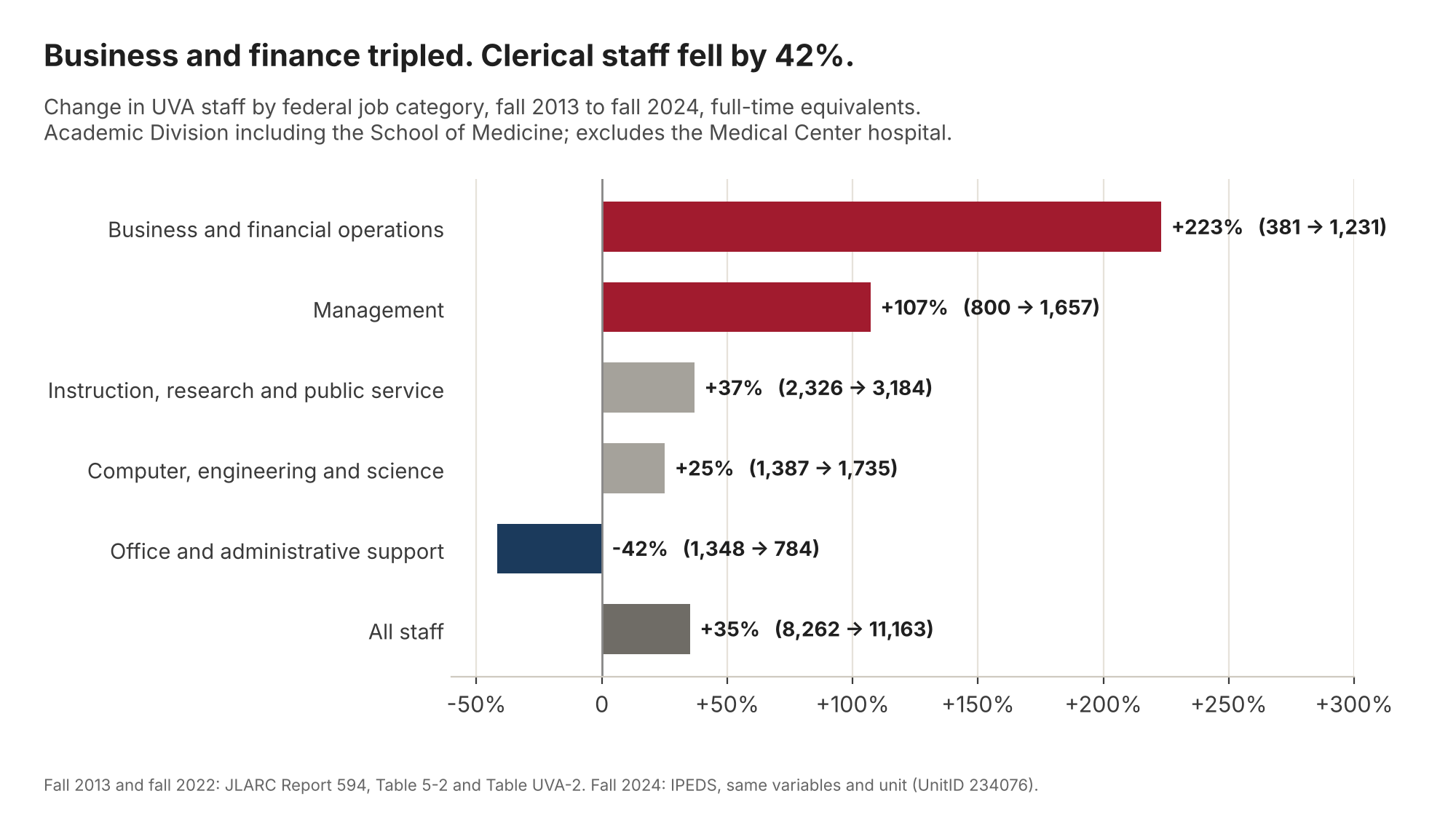
Total staff grew 35% on JLARC's basis between fall 2013 and fall 2024, and 36% on the non-medical count. But the size of UVA's workforce is not the total story. The question is what kind of jobs it chose to fill and how much they cost.
The two biggest and costly operations grew the most - the professional administrative workforce, such as accountants and auditors, budget analysts, human resources and compliance specialists, the VPs, deans, and directors who run UVA's units.
The only category that decreased was the lowest paid category. Office and administrative support, the secretaries, assistants and clerks who once did much of UVA's paperwork, shrank by 42%.
Students, faculty, and administrators
So how does the extraordinary expansion of the administrative bureaucracy compare with the growth of the fundamental groups a university is supposed to serve – students and faculty?
Over the past decade, UVA's administrators grew about eleven times as fast as its student body and four and a half times as fast as its instructional staff.
To measure that, we used UVA's own federal filings, with the School of Medicine taken out. The medical school employs a large share of UVA's research and clinical staff, and removing it keeps the focus on the part of the University that educates undergraduates. These are full-time staff headcounts from fall 2013 to fall 2024. "Administrators" means management plus business and financial operations. "Instructional staff" means full-time employees whose main job is teaching.
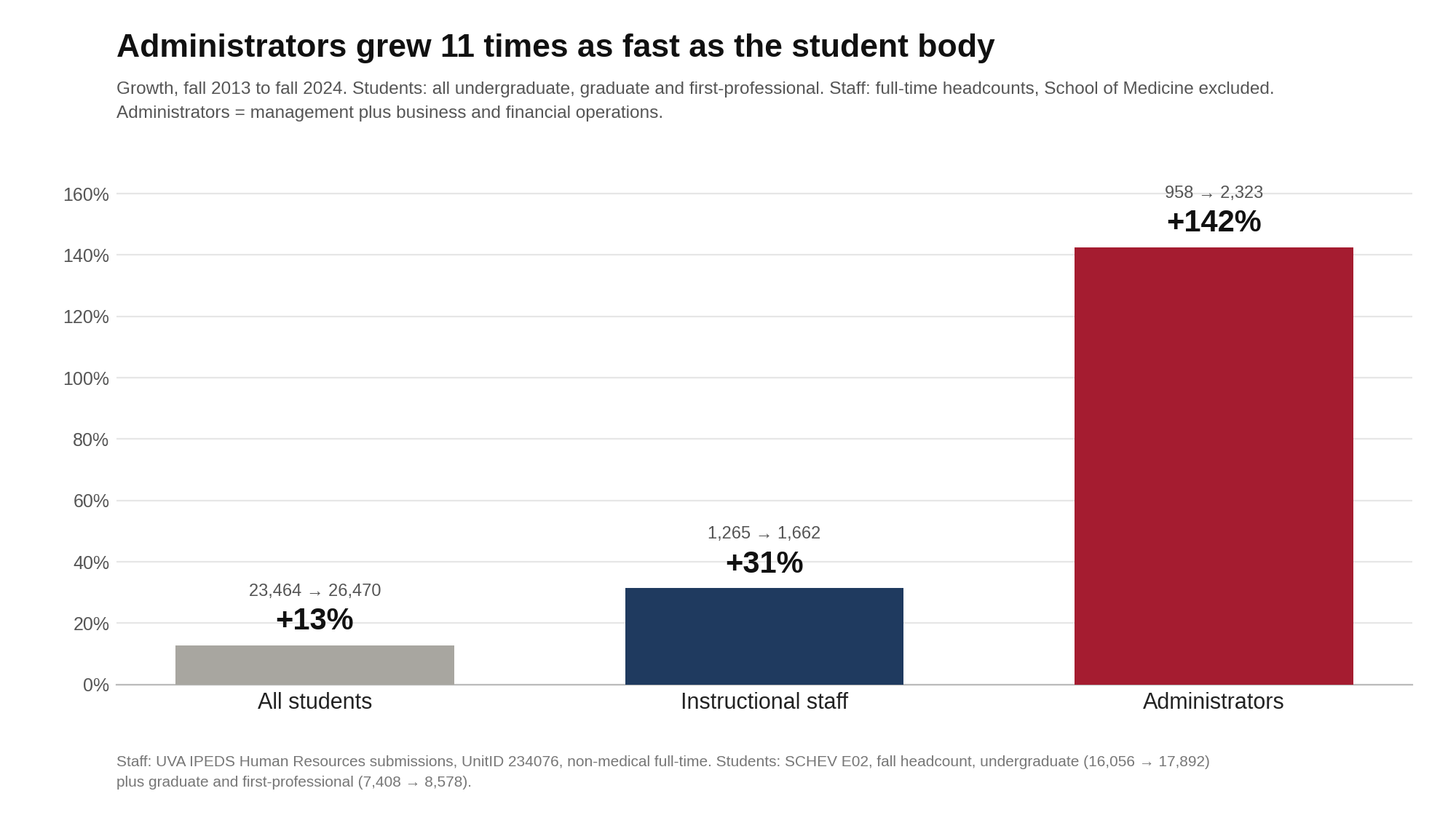
The gap is stark. Between fall 2013 and fall 2024, administrators grew about four and a half times as fast as instructional staff, and about eleven times as fast as the student body, graduate and professional students included.
What that looks like on the Grounds
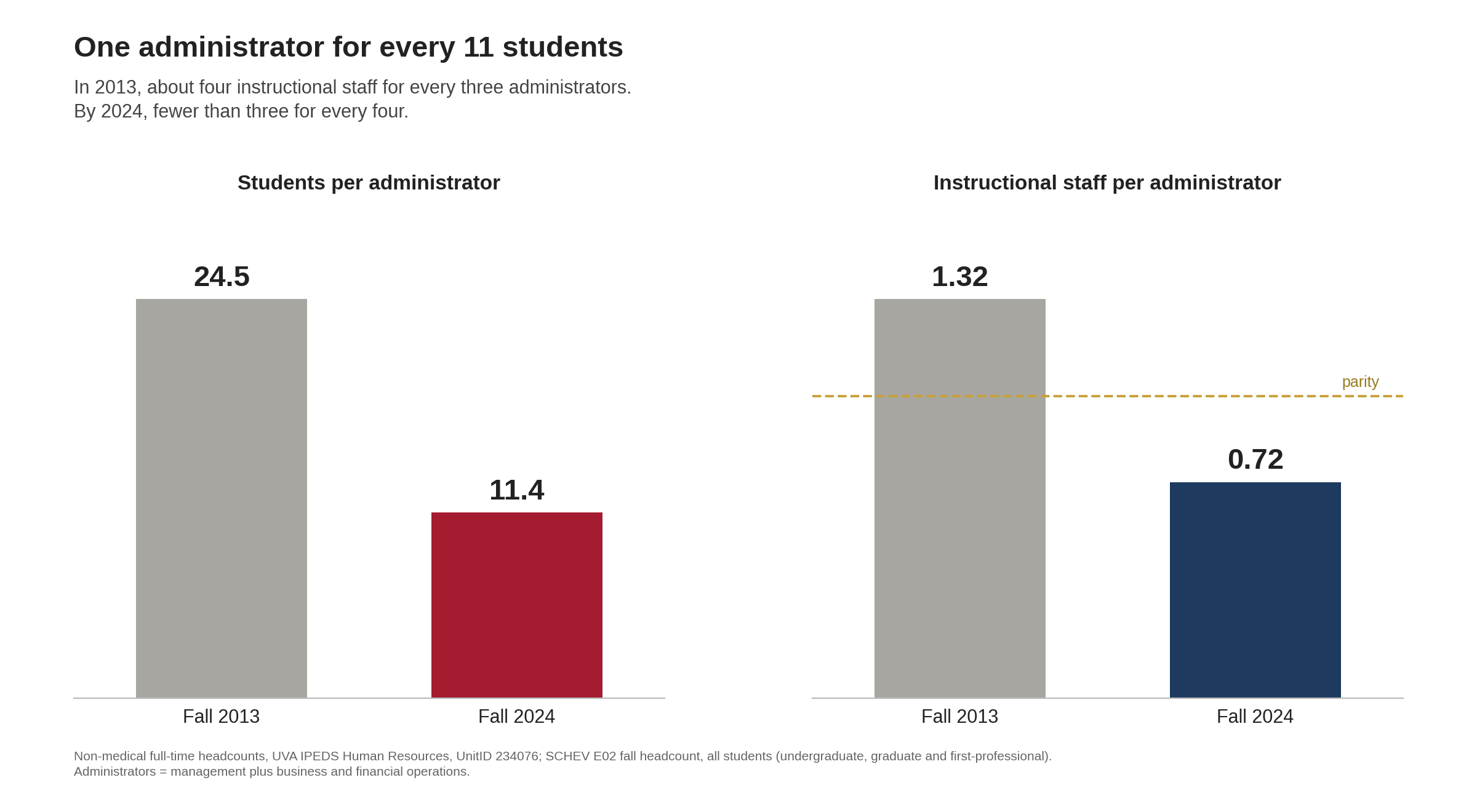
In 2013, UVA had one full-time administrator for roughly every 24 students. By 2024, it had one for about every 11. In just over a decade, the number of administrators per student more than doubled.
The balance with faculty flipped too. In 2013, there were about four instructional staff for every three administrators. By 2024, this was essentially reversed, there were fewer than three faculty for every four administrators.
Following the money
We've seen the growth in numbers. Let's take a look at the bottom line – what the bureaucratic bloat has cost students and faculty.
In October 2012, UVA's Board of Visitors hired a new COO at $450,000 a year. Fourteen years later, UVA's own salary filing to the General Assembly lists the job at $1,018,000. Even after inflation, that's a raise of roughly 60%.
Most of it came in the last five years, under the same officeholder. In 2021 the post paid $629,200. Over five years when prices rose about 19%, the COO's pay rose 62%, past the million-dollar mark. The two biggest raises came after the Board created a compensation subcommittee in 2024 to advise on senior executive pay. Which positions it would review was never decided in public.
The COO wasn't alone at the top. UVA's chief fundraiser, now senior VP for external relations, went from $630,000 to $855,711 over the same five years. And the interim provost is listed at $851,500, more than the last permanent provost was paid.
But headcount is the real story. Between fall 2013 and fall 2024, UVA's inflation-adjusted payroll for management and business and finance more than doubled, up about 130%, and the number of people in those jobs rose even faster, up 142%. UVA didn't get expensive only by paying the typical administrator more. It also got expensive by adding more administrators overall.
None of this started from a modest baseline
In 2014, the General Assembly's watchdog agency, the Joint Legislative Audit and Review Commission (JLARC), took a hard look at UVA. It found that UVA was already one of only three Virginia institutions paying its top administrators more than 10% above comparable public universities nationally.
The titles kept climbing anyway. UVA had three vice provosts in 2005; by 2025 it had nine. On the university-wide organization chart UVA posted online until 2025, associate and assistant VP titles in the academic division grew 44% between 2019 and 2025, faster than the 29% growth in posts listed.
Some jobs simply moved up a rung. The president's chief of staff was an assistant VP on UVA's 2018 and 2021 charts. In 2023 the Board made the post a VP position, at $310,000, without adding a single unit beneath it. By 2026 the post was listed at $410,000. The chief information officer had no VP rank in 2019. A year later the post had one, at $360,400, and the next CIO was hired in 2023 at $400,000. The office underneath never changed.
Snapshot I: Communications
As an example of the extraordinary bureaucratic bloat, take University Communications, the office that speaks for UVA. In September 2019, its own website listed 38 staff. By June 2025, its organization chart showed 47, a 24% increase in less than six years, most of it after 2022. The office's leadership grew taller along the way. The office's chief of staff was raised to an assistant VP, and in 2023 the office listed five associate or assistant VPs at once. Meanwhile, the VP who runs it saw his base salary rise from $367,500 in 2021 to $464,980 in 2026, up 27%.
UVA's budget books show University Communications' salary budget is $7.08M in fiscal 2027. Below we'll show how that compares with how our academic faculty are compensated.
Snapshot II: UVA's New Division for Community Engagement and Equal Opportunity
After March 2025, much of UVA's Division for Diversity, Equity and Inclusion became the Division for Community Engagement and Equal Opportunity. The name changed. The leadership did not. Kevin McDonald, who has led the office since at least 2019, first as VP for DEI and later as VP for DEI and community partnerships, still runs it under his new title, and several offices were consolidated underneath him.
The new division is not small. UVA's current payroll records list at least 43 people across its three offices. Its five highest-paid employees earn $413,509, $288,549, $217,379, $205,480 and $201,280. All five earn well above the average UVA faculty salary of $144,240.
Beyond the VP, the division has its own chief of staff, its own director of budget and finance, and its own director of assessment and data analytics.
It is also getting bigger, at least on paper. UVA's budget for FY2027 sets aside $8.57M for salaries in the VP's office, up from $4.47M in FY2026, a 92% increase in a single year. It is unclear whether that reflects new hires, offices moved in from elsewhere, or both. It really doesn't matter anyway – what does this division have to do with UVA's academic mission?
Bureaucratic Bloat vs the Faculty
Both departments discussed above cost more in salaries than most of the academic departments that teach UVA students. For example, University Communications is budgeted for $7.08M in salaries this fiscal year and the Division for Community Engagement is budgeted for $8.57M. Each is more than UVA pays the entire faculty of its Chemistry department ($5.6M), Physics ($5.7M), Mathematics ($4.5M), Sociology ($3.7M), or Classics ($1.2M). It's about what Physics and Classics pay their faculty combined. Of seven core arts and sciences departments we examined, only English ($11.2M) costs more than either. History ($7.8M) falls between them: slightly more than Communications, but less than Community Engagement.
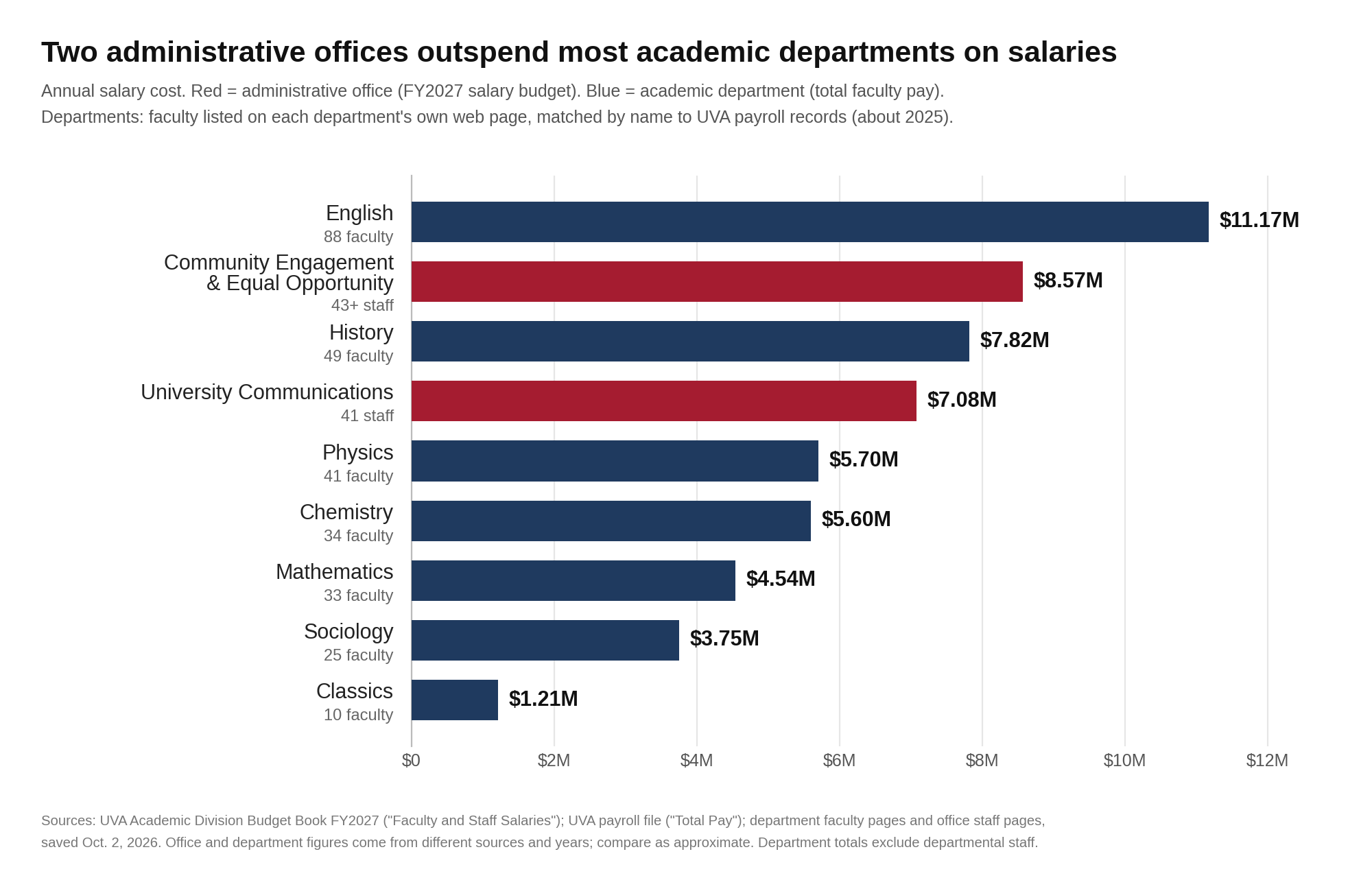
The comparison is about people as much as dollars. Communications currently lists 41 staff and Community Engagement has at least 43. The Chemistry department has 38 faculty, and Mathematics has 38, counting its lecturers. Those faculty teach calculus, organic chemistry and introductory physics to thousands of undergraduates a year.
According to the yearly Cavalier Daily analysis of salaries, for 2026, the average salary for all faculty was $144,240, and $106,387 for general faculty.
A university rebuilt around administration
Many of us have learned in our government courses at the University that the essence of any bureaucracy is attaining growth and power. That is clearly what has happened at UVA.
What should be the priorities at our university encompassing our students and faculty has shifted both in numbers and monetarily to an ever-growing bureaucracy.
Over the past decade, UVA's administrative staff grew far faster than its teaching staff or its student body. Somewhere along the way, UVA stopped asking what administration was for and started asking how much more of it there could be. Mr. Jefferson founded an academical village; his successors have built an administrative city around it. The bureaucracy grew because that is what bureaucracies do, and no one has had the courage or wisdom to stop it.
About the numbers: Student figures are fall headcounts, full- and part-time, from the State Council of Higher Education for Virginia (SCHEV E02 report), and include undergraduate, graduate and first-professional students: 23,464 in fall 2013 and 26,470 in fall 2024 (16,056 and 17,892 undergraduates; 7,408 and 8,578 graduate and first-professional students). Staff figures are from UVA's submissions to the federal IPEDS survey. The comparison of administrators, instructional staff and students uses full-time headcounts, excluding the School of Medicine. The staffing figures in "How that happened" follow JLARC's method: full-time equivalents for the Academic Division, including the School of Medicine.