
What Thirty Years Did to UVA's Price Tag
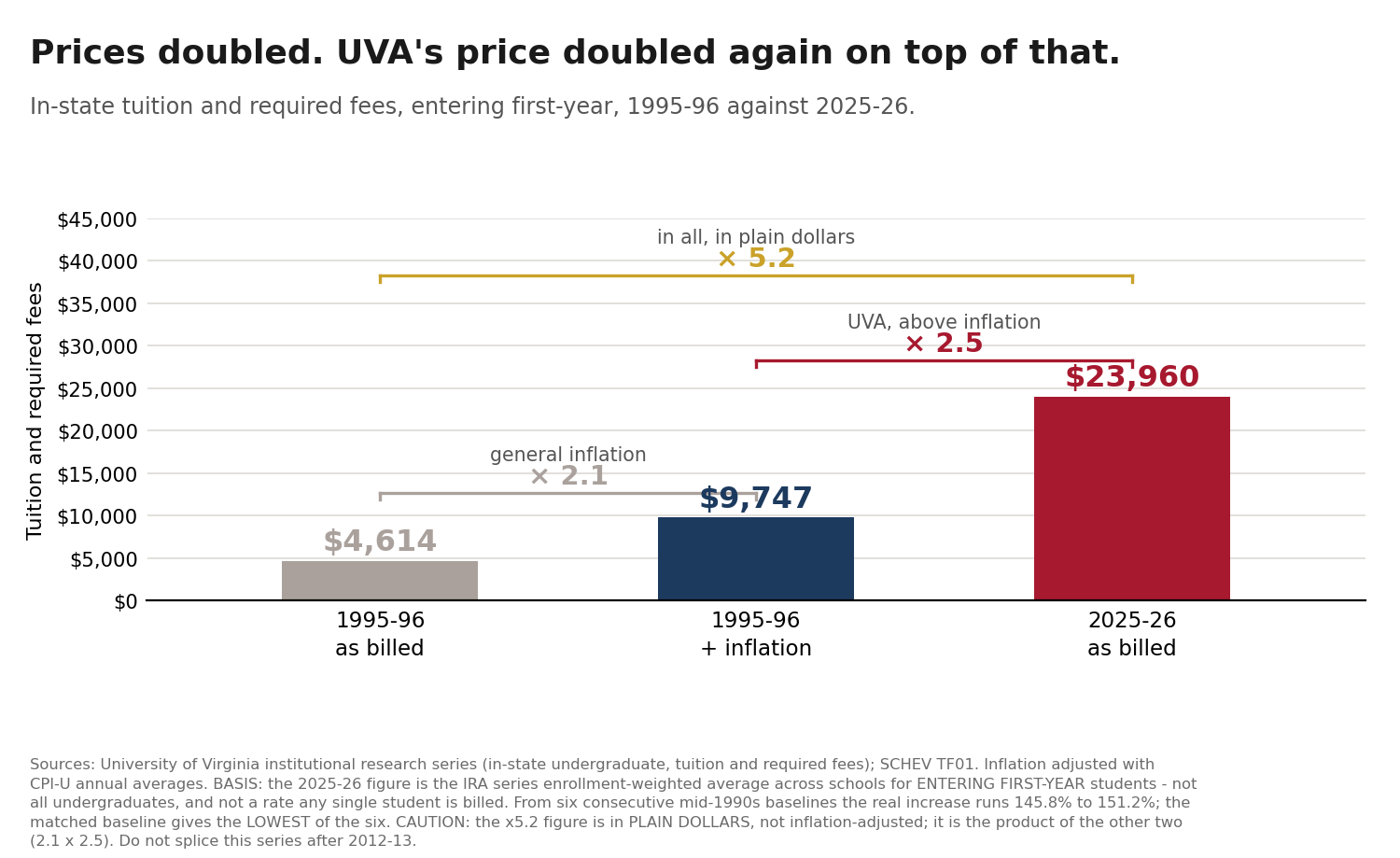
In the fall of 1995, a Virginia family sending a kid to UVA got a bill for $4,614 in tuition and required fees. Thirty years later, an entering first-year is billed $23,960 on average.
Prices go up. That's not the story. The question is how much of that jump is the same rise that hit groceries and rent and gas over those thirty years, and how much is something else.
Take that $4,614 and run it forward with the government's standard price index. You get about $9,700. That's the bill a Virginia family would be looking at today if UVA had just kept pace with the cost of living. The actual first-year bill averages $23,960.
The difference is about $14,200 a year. Over four years, that is roughly $56,900 that inflation doesn't explain. Put it plainly, the amount above inflation by itself is more than three times larger than the whole 1995 bill. What’s more, in plain, unadjusted dollars, today’s bill is 5.2 times what it was in 1995. Prices in general roughly doubled over those thirty years. UVA's price doubled again, and then some, on top of that.
Why a thirty-year span?
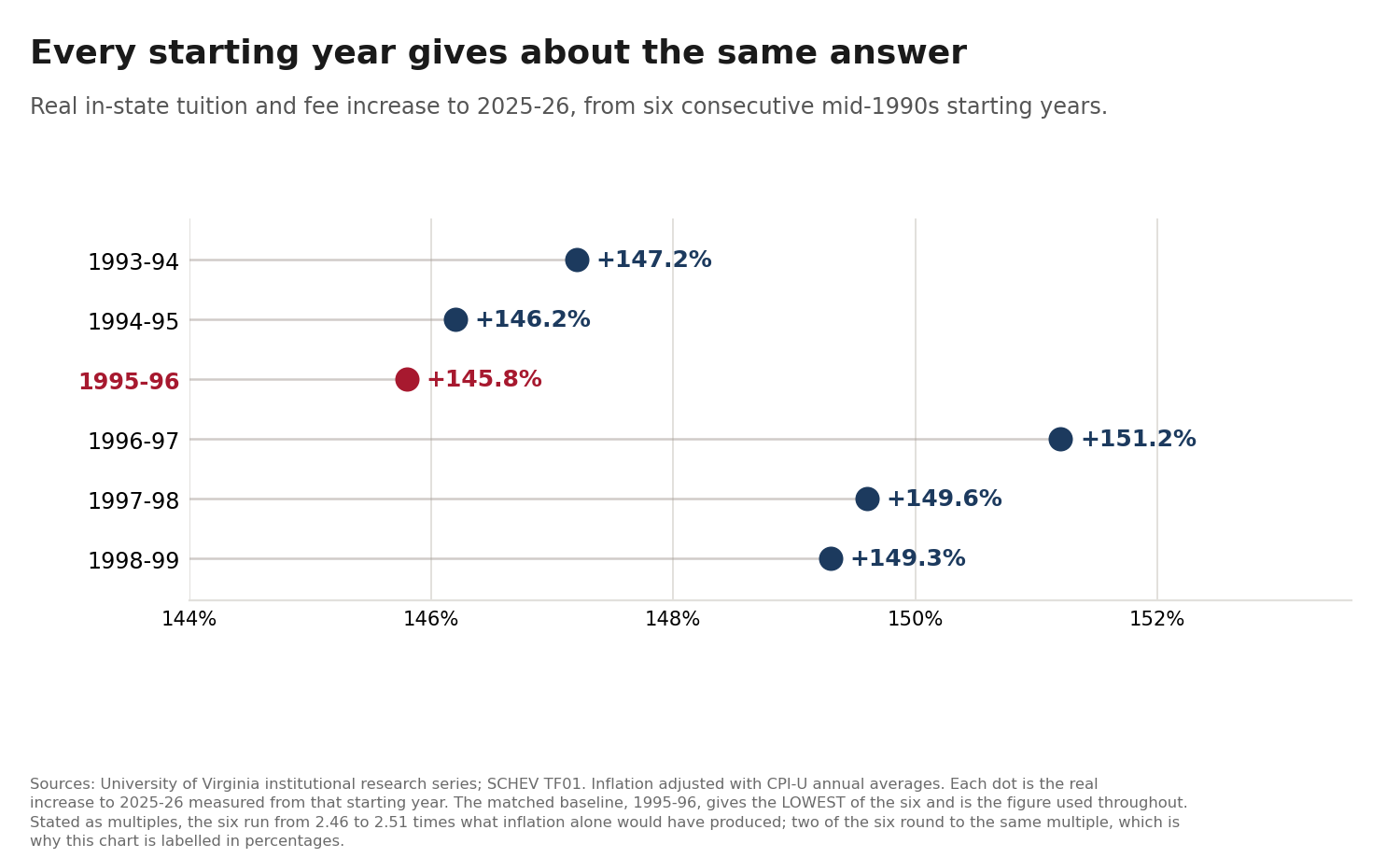
Pick a different starting year and you get a different number, and anyone making an argument like this one should have to answer for the year they picked. So we ran it six different ways, starting from six years in a row in the mid-1990s. The results were essentially the same. We used the lowest differential.
The $23,960 average even understates things, because it follows entering students only. The single price ended in 2011, when the Board of Visitors created a $3,000 differential for third-year Commerce students and nobody else. Today UVA charges twelve program-and-year rates at eight price levels. In Arts & Sciences, third and fourth years pay $3,092 more than first and second years.
The figures in this piece describe the first year of a UVA education. The number that reaches the public is the lowest one, and the first year is the cheap end.
The part of the bill that never gets talked about
Tuition and fees are only part of what a student living on Grounds is billed. The other part is room and board, and over the last thirty years it rose almost as fast.
In 1995-96, housing and a meal plan at UVA cost $3,846. In 2025-26 the same line is $15,318 — nearly twice what inflation would have produced on its own.
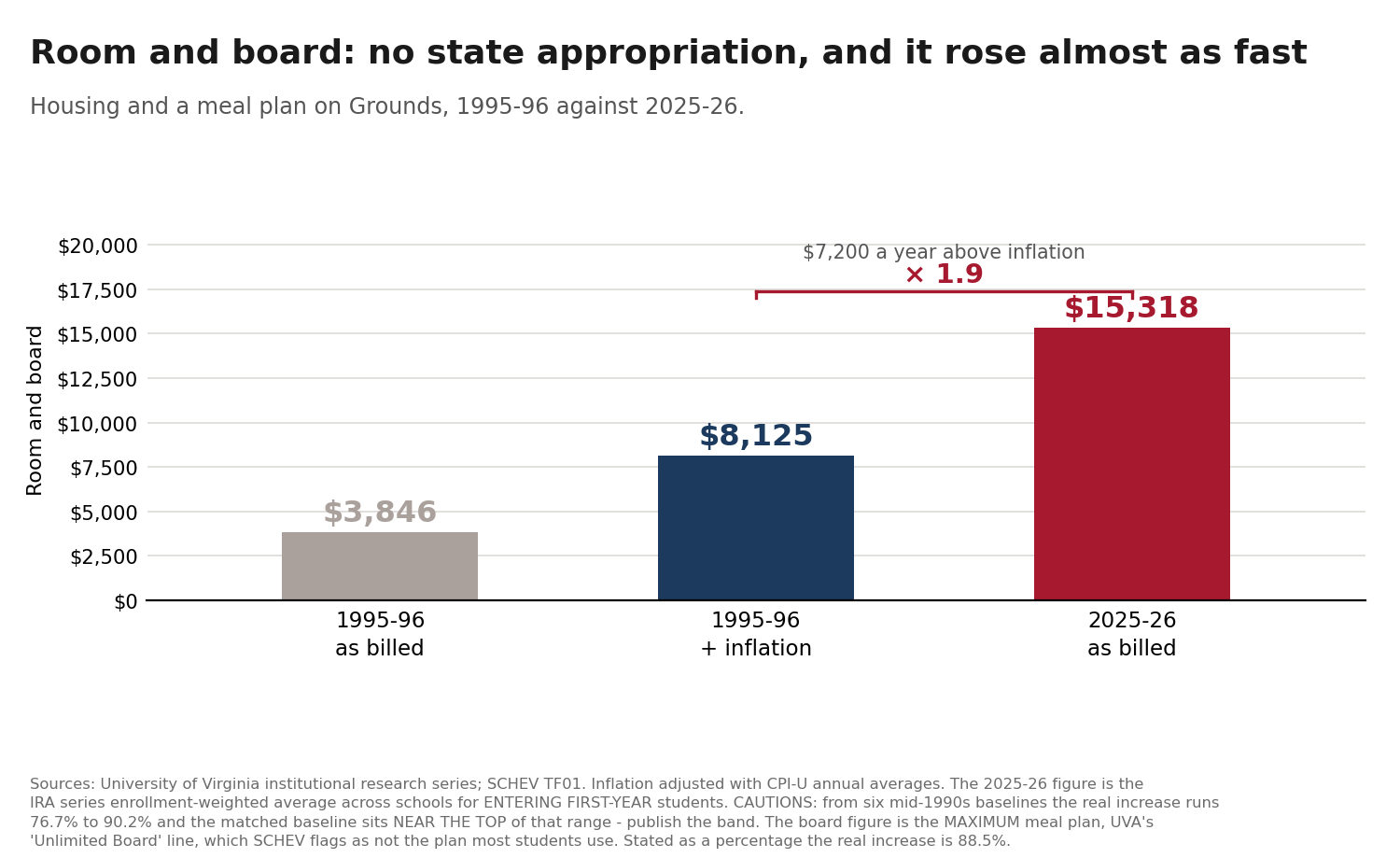
Room and board is what the state classifies as an "auxiliary operation." It receives no state appropriation and is funded almost entirely by what students pay. Mandatory non-educational fees cover the same kind of thing: athletics, student activities, transit, health services.
Until 2019-20, UVA published its "Total Price of Attending UVa" sheet, which listed housing and dining as separate line items. From 1995 through then, after inflation, housing more than doubled, while board rose about 60%. UVA no longer updates that sheet and publishes nothing comparable. The only continuing source is the State Council of Higher Education for Virginia (SCHEV), which reports room and board as a single combined figure.
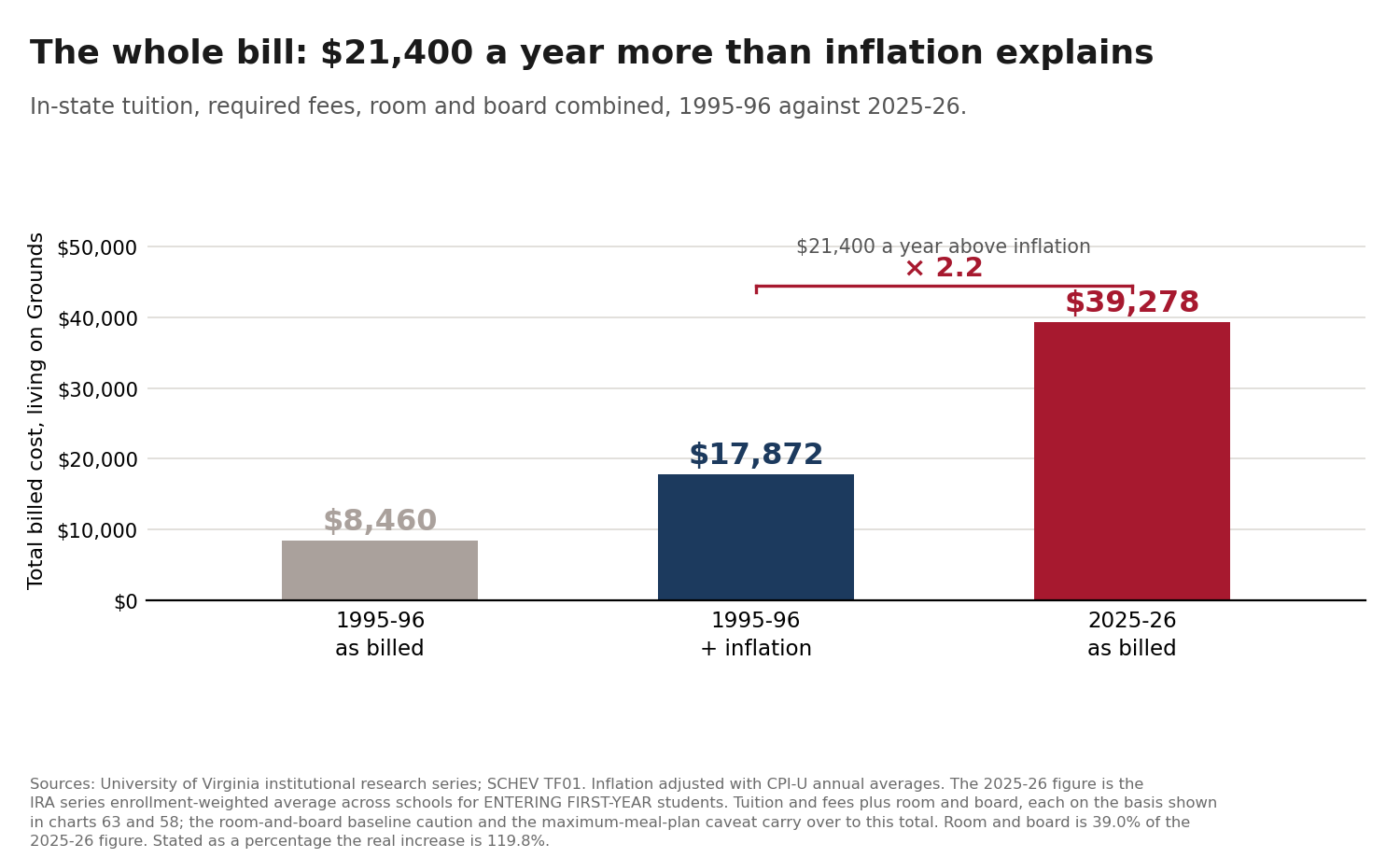
Food got expensive. Housing got much more expensive. So for an entering first-year living on Grounds, the full bill averages $39,278. Room and board is 39% of it, and for first-years, living on Grounds is mandatory.
But take note: UVA will be changing that. Phase II of the 2030 Plan says, "we will establish a series of residential communities that will house all first- and second-year students on Grounds." UVA families beyond first-years will soon be locked into UVA housing and its prices for another year. Is UVA telling anyone that?
What out-of-state students pay
UVA charges non-Virginians a different price, and the same thirty-year test reveals a similar trend.
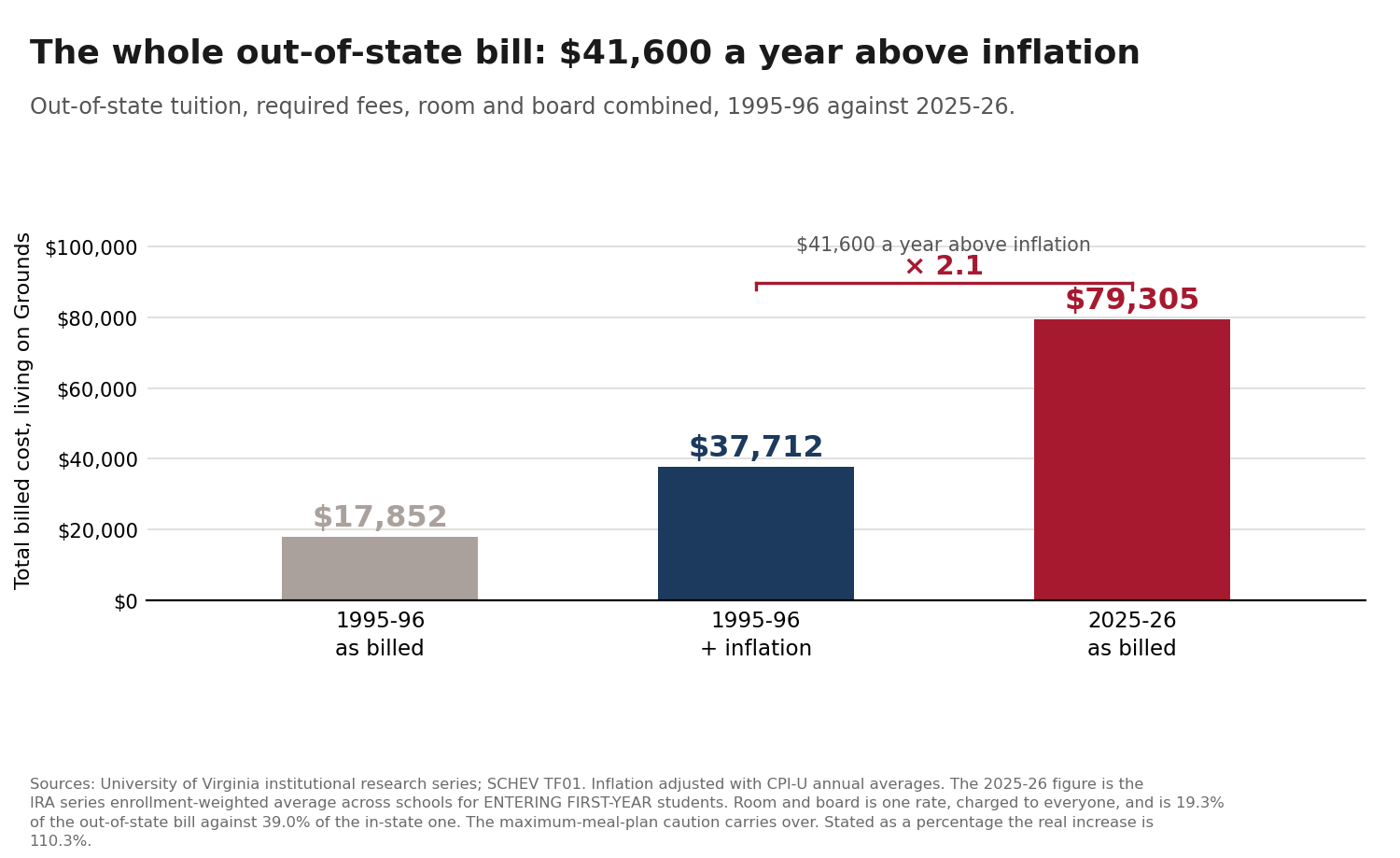
In 1995-96, an out-of-state student was billed $14,006 in tuition and required fees. Today the figure is $63,987. Carried forward by inflation, that 1995-96 bill would be $29,587 — so the price is a little over twice what inflation explains, about $34,400 a year more, or roughly $137,600 across four years. Room and board is the same line for everyone. The full out-of-state bill for a first-year student is $79,305.
Why it matters
A family deciding if UVA is affordable is not just looking at tuition. They are looking at a total bill. Averaged across the schools, that bill is now about 2.2 times what thirty years of inflation would have produced — and the same is true for out-of- state.
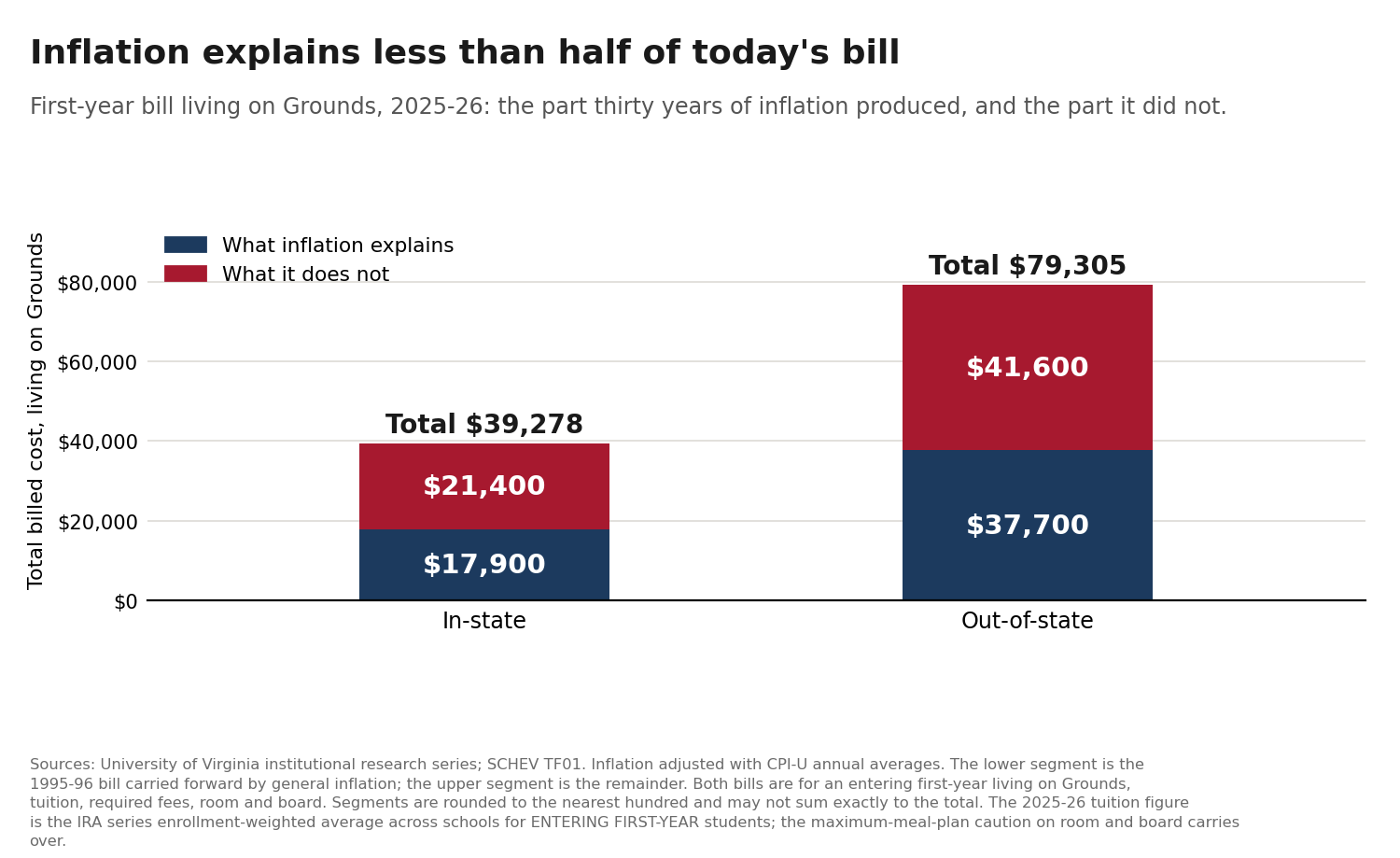
Here's what it comes down to. Of the $39,278 an entering first-year Virginian is billed today, about $17,900 is what thirty years of ordinary inflation would have produced on its own. The other $21,400 wasn't set by inflation. For an out-of-state student, the share inflation doesn't explain is $41,600. In both cases, inflation accounts for less than half the total bill.
The rest is a series of decisions: a long run of them, made by each administration and Board of Visitors year after year.
The reasons behind the extraordinary rise in student’s costs will be discussed in a series of articles to follow. Stay tuned.
Sources: Tuition and fee figures from the University of Virginia's institutional research series, 1970-2026; the published base rate and the state comparison from SCHEV's TF01 report. Room and board from UVA's published rate sheets. Inflation adjustments use annual average CPI-U through 2025-26. Stated as percentages, the real increases are 145.8% for in-state tuition and fees, 88.5% for room and board, 119.8% for the in-state bill, 116.3% for out-of-state tuition and fees and 110.3% for the out-of-state bill.